In Conversation with Guiseppina Bridelli: “It was the smell of theatre dust that drew me into opera"
Rubrik Interviews
©Yohan Justet
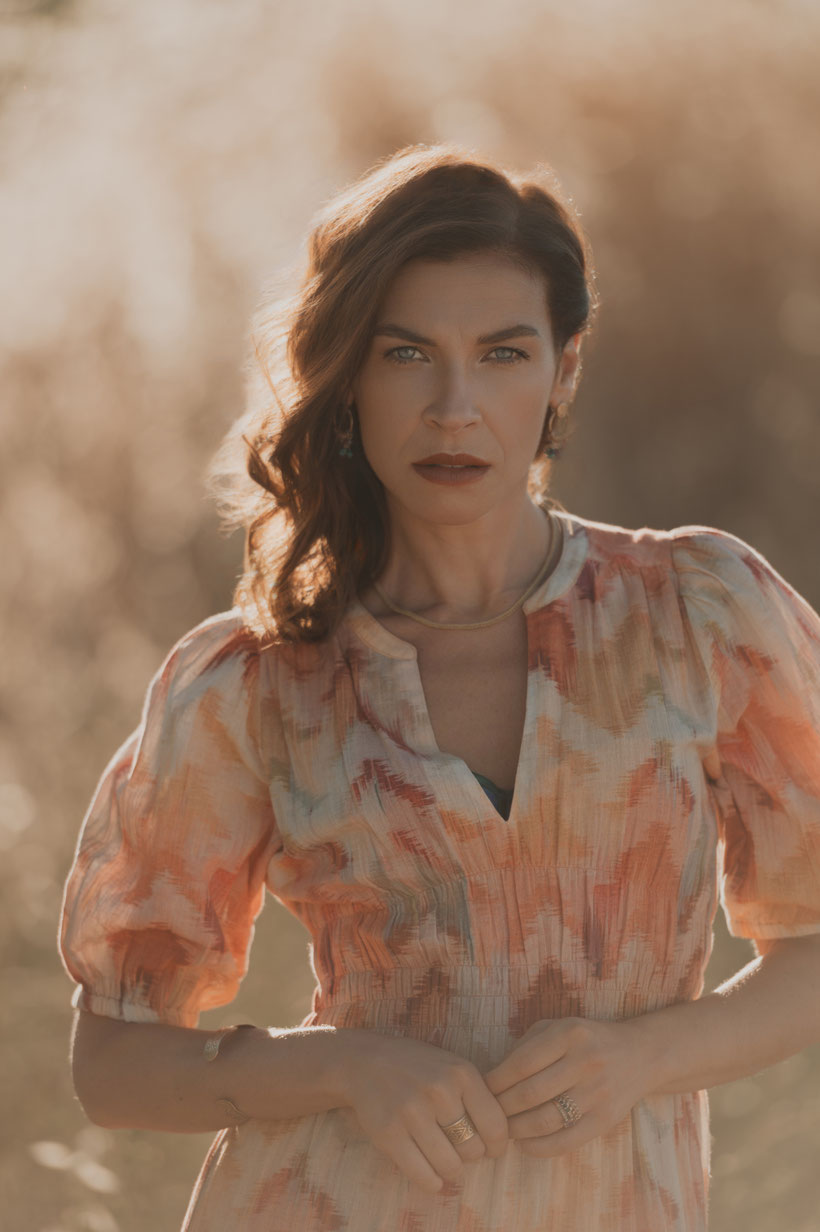
In a world where operatic voices often strive for sheer grandeur, Giuseppina Bridelli draws her strength from something quieter, almost elusive: intimacy! Her musical world is rooted in early memories, special family moments shaped by shared listening of the opera repertory and the unmistakable atmosphere of theatre spaces that first awakened her imagination.
Growing up in the cultural orbit of Giuseppe Verdi’s homeland, her path might have seemed almost prewritten; yet instead of following an expected trajectory, she found her artistic identity in the delicate, introspective landscape of early music.
For Giuseppina Bridelli, the human voice is never abstract, it is something lived and embodied, formed through years of singing in children´s choirs and an instinctive, almost physical understanding of musical language. Her affinity for Baroque repertoire unfolds as a dialogue between voice and history, where word, tone and emotion remain inseparably bound together.
Balancing the roles of performer, teacher, and mother, she emerges as an artist in continuous transformation, guided less by fixed career destinations than by an attentive, unfolding process of becoming.
Operaversum: Do you remember the moment when you first fell in love with classical music and opera in particular? What made you persue a career in opera singing?
Giuseppina Bridelli: I consider myself very fortunate, because I was born into a family in which opera was always present, rather than being something exceptional or distant. My parents were deeply passionate about this musical genre and I recall many moments of gatherings where we jointly listened to opera, especially on Sunday mornings, when all the family was at home.
There was also a kind of family tradition as the cousin of my grandmother´s was a well-known tenor in the 1950s, and although he was not a close relative, his presence remained vivid through the stories my father would tell us. He always described how this man would arrive at his grandparents’ house in a large car, like a figure from another world, almost mythical so to speak. In this way, opera was not only something we listened to; it sort of inhabited our imagination, plus I come from Piacenza, near Parma, in what is often regarded as the homeland of Giuseppe Verdi.
There is also a deeply rooted vocal tradition there and Verdi very much forms part of the region’s cultural identity. Even today, people still debate where exactly he was born. Growing up in such an environment, music was never an abstraction for me, but something that emerged from the landscape, from the people and from everyday life.
So almost naturally I began singing as a child and spent many years in the "Coro Farnesiano" in my city, which felt very much like a second family to me. It was there that I became fluent in reading musical scores at an early age, something that has remained foundational ever since. You see, when one engages intensively with music education in childhood, it becomes internalised and is then no longer an external skill, but something very instinctive and practised by nature.
Even today, I find that I can read and assimilate a score with a certain immediacy, perhaps more intuitively than many other singers. And I am convinced that this stems directly from those formative experiences.
Through my years in the choir, I also had my first touch-point with opera, singing in children’s choruses in works such as La Bohème and Carmen.
But what has remained most vividly in my memory, however, is something very specific: the smell of the theatre, which is the dressing rooms, the dust, the interior material. There is a particular scent that belongs uniquely to these musical spaces. For me, it is inseparable from the discovery of a world that felt both mysterious and deeply compelling to me. It marked, in a sense, my first real encounter with the opera stage.
Operaversum: This is completely new aspect of how someone can be drawn to a theatre just by it´s smell. But I would give it a thought!
Giuseppina, you are widely recognised for your work in the Baroque repertoire, yet your artistic path spans a remarkably wide range from early music to contemporary works. How do you nagivate such diversity and what guides your choices when moving between styles and eras?
Giuseppina Bridelli: I believe, that first and foremost it is the voice that decides upon the choice of repertoire as it clearly reveals what one is capable of singing, what matches one’s timbre and artistic nature and equally, what does not. It is something we must respect, because it defines both our vocal possibilities as much as our limitations.
At times, this also means accepting certain boundaries. I come from a region where Verdi is central, and yet he is a composer I will most likely never perform in any bigger role. I have sung some smaller roles, and I have come to accept that. And still, when I listen to his music, I feel a profound connection to it, as it evokes emotions about my homeplace, the landscape, the atmosphere. When I see the countryside around Piacenza, I have the impression that Verdi´s music truly originates from that special place.
At the same time, what may appear as a "vocal limitation" can also open unexpected paths. For example it is precisely through the nature of my voice that I discovered other repertoires, particularly the music of the 17th century. Had my voice been different, I might never have encountered composers such as Monteverdi, Cavalli, or Rossi.
So in the end this repertoire has become a deep artistic affinity for me. It is extraordinarily delicate, subtle, and refined. which means one must be attentive to every nuance, every interval, every harmonic shift, every word. This particular genre requires a heightened level of awareness and a profound engagement with both text and sound.
At the same time, I do not confine myself to a single stylistic field. I also perform contemporary music, and I continue to explore other repertoires. This year, for instance, I am singing Rossin´s Il Barbiere di Siviglia and La Cenerentola, which gives me great joy.
Thus said, I also believe it is essential to remain open: to explore carefully, to test the voice within its natural boundaries, and occasionally to extend it into yet unkown repertory. Since the voice constantly develops as in maturing, one should be open to embrace this development with both curiosity and discernment.
©Yohan Justet
Operaversum: Dear Giuseppina, you made your opera debut at a very young age and after nearly two decades on stage you are already teaching at one of Italy´s most prestigious conservatories, the "Conservatorio di Santa Cecilia" in Rome. How do you balance performing and teaching and how do these two dimensions influence one another?
Giuseppina Bridelli: Well, that for sure requires a high level of organisation. Without it, nothing would be possible, especially now, that I have a young daughter. So every aspect of my life must be carefully structured.
Recently, for example, I spent several days in Rome, teaching for nine hours a day. So I brought my daughter with me and my mother accompanied me to help and take care of her. These were intense days, but also deeply rewarding ones.
You know, teaching is something very personal to me, because I was fortunate to find my own teacher at a young age when I was just sixteen. Fortunately she has remained my teacher ever since. For singers, this relationship is particularly significant, as the vocal chords logically reside within the body. They are not something external that can simply be observed; they must be discovered and shaped from within. And of course this requires a very particular kind of guidance.
Even today, I continue to work with my teacher and will also see her again soon, as I prepare a Donizetti opera for Teatro La Fenice, a role that demands careful and precise preparation.
Knowing what it all takes to shape a voice, I feel a strong responsibility towards my own students. Even thoug teaching is demanding and requires energy, concentration, and time, it is equally deeply fulfilling. To witness a student’s development, to observe their curiosity and their desire to study, is something profoundly rewarding for me.
And maybe surprisingly, teaching also nourishes my own work as a singer. It becomes a continuous process of revisiting technique through vocal demonstrations, explanations and refinement. In teaching, one is constantly brought back to fundamental principles, often rediscovering aspects that might otherwise recede into the background.
Operaversum: Do you still feel that you are learning as a singer whilst teaching?
Giuseppina Bridelli: Very much so. The voice is not a fixed entity. It evolves together with the person. As we change and mature, the voice changes with us. It is something that develops continuously, not something that can ever be considered as finished.
I often think of a remark attributed to Maria Callas, who is said to have reflected that it takes many years to truly learn how to sing, and then many more to maintain and refine one’s technique. Whether taken literally or not, I find the idea itself very truthful.
As you know, I began my vocal studies more than twenty years ago, and I still feel that I am in a constant process of learning. That, for me, is one of the most compelling aspects of this profession as it is never complete, but always in motion, a continuous evolution that never truly concludes.
Operaversum: Giuseppina, you are about to release a new recording with Michele Pasotti, called "Luci mie. Musiche per gli occhi del Seicento italiano ("My lights: Music fro the Eyes in the 17th Century Italy"), which you have already previewed in a concert in Genoa.
The title is striking and evokes a deeply seventeenth-century theme: that of the eyes and it´s expressiveness and emotional mirror. What drew you to this concept and what was the thread that guided your choice of repertoire?
Giuseppina Bridelli: This repertoire was developed out of a close artistic collaboration and friendship with the lute player and conductor Michele Pasotti. We had already performed together on several occasions, but at a certain point we felt the desire to create something more lasting, a recording that could reflect our shared musical thinking in a more defined form.
So we decided on a 17th-century repertoire, which is particularly dear to both of us and especially well suited to intimate musical moments, which is voice and lute. We are talking about a repertoire that naturally invites closeness and transparency, both in sound and in expression.
During the process of gathering our ideas, the conceptual idea gradually emerged from the music itself. In this repertoire there is an intense relationship between word and sound, which is known as "madrigalismo", where music does not simply accompany the text but actively reflects it, almost illustrating or “painting” the meaning of individual words, so to speak a rhetorical approach shared by composers and poets of the time.
While working through different sources, we began to notice how frequently the image of the “eyes” appears across these works, that we compiled together. So that is how the idea of the programme slowly took shape.
What we then did was to build a musical journey around this concept, selecting pieces that explore this emotional imagery in different ways. The repertoire itself includes both well-known works, such as pieces by Monteverdi, and lesser-known or even unpublished compositions. But what connects them is this continuous reflection on emotion as it is expressed through the symbolism of the eyes.

©Yohan Justet
Operaversum: Some listeners of Baroque music describe it´s style as emotionally more contained compared to the sweeping drama of Verdi or Puccini operas. When you are out on stage, how do you bring that emotional spark of Baroque music and make it resonate with the audience?
Giuseppina Bridelli: First of all, I think music, opera, and the voice are always a matter of taste. It is something deeply personal, one can like or dislike, and that in itself is entirely legitimate. Even for me, there are singers who move me profoundly and perhaps do not move someone else at all, and vice versa. This is part of what makes music so alive and human.
Ultimately, emotional response cannot be fully controlled or defined. We can speak about rhythm, intonation, or sound quality, but the most important layer, the emotional dimension, remains subjective. For me, what defines Baroque music is precisely its scale and its intimacy. It is often chamber-like in nature, performed with small ensembles rather than with large orchestral forces backing it up. Also the "auditoriums" are different spaces in Baroque music as they are more contained and closer to the audience.
I remember being in Versailles once, where the performance spaces are still relatively small and create a very direct relationship between musicians and audience. In such a setting, everything becomes more concentrated: the words, the sound and how the music is being transported into the audience.
So in Baroque music, emotion emerges less through volume or power and more through proximity and precision. Every word carries weight; every nuance is audible. There is a very direct exchange between performers and listeners.
Of course, I also feel the emotional force of other repertoire very strongly. Verdi, for example, speaks to me in a powerful and very different way. But the mechanism is not the same.
What is essential to understand is proportion. A small ensemble, a continuo line, and a voice that often remains in a central register cannot and should not be compared to the scale of Romantic opera. It is not about being more or less expressive. We are just talking about different aesthetic worlds.
And once you understand the difference in porportion, the emotional language of Baroque music becomes clear, as its intensity lies in restraint, in detail, and in the closeness between sound, word, and listener.
Operaversum: This a truly new take on how I will perceive Baroque music as of now. Let us take a look back on when you started out your career, can you tell me about your most touching stage experience and what made it so special?
Giuseppina Bridelli: Oh, that is a difficult choice, because there are many moments that are precious for me for different reasons, some of them for purely musical reasons, others because of the people and collaborations involved. Music is often remembered through these shared experiences. But if I may, I would love to choose two musical events:
one unforgettable stage experience I had was in 2022, when I sang in my first French Baroque opera, Atys by Jean-Baptiste Lully. It was a real discovery for me and we performed it in both Geneva and in Versailles.
I remember it was a very special production, staged by choreographer Angelin Preljocaj with his dance company, which brought a strong physical and theatrical dimension to the music. So it fit Lully’s world naturally, since this repertoire is closely linked to dance. Atys itself is also historically significant as it was the favourite opera of Louis XI and it had not been revived in this particular way since an important production in the 1980s associated with William Christie.
On a personal level, it was also an intense moment in my life, because I was pregnant with my daughter at that point in time. So the artistic and private dimensions came together in a very particular way. I was also working with Cappella Mediterranea and Leonardo García Alarcón, with whom I have a long-standing artistic relationship, which alltogether gave the project great trust and depth.
The second and very special stage moment has a more musical facette to it, but is equally important and took place last year, when I performed Bach for the first time at the Théâtre des Champs-Élysées in Paris, a key venue for Baroque repertoire.
It was particularly meaningful for me as an Italian singer, performing German Baroque music, especially Bach as it is not something one encounters so often in a central repertoire role. Musically, Bach speaks to me very deeply in the perfection and clarity of his compositorial structure. The Matthäus-Passion in particular is one of the works I feel closest to as it is extremely profound, intense, and moving.

©Marco Caselli Nirmal
Operaversum: After a performance, when you leave the stage, do you carry the character with you for a while, or are you able to make a clear separation between stage and private life?
Giuseppina Bridelli: I think what I take with me is above all the emotion that the evening and the performance have given me. That is something I try to keep with me, because it is one of the reasons why this profession makes sense despite its complexity, the constant travelling, and the organisational demands.
For me it is important to hold on to what makes me feel truly happy in those moments. But at the same time, I also try to keep my private life separate and intact, as it is. There needs to be a balance between the two.
Of course, I believe everyone handles this differently. Some people stay in the role longer, others are able to step out of it more immediately. But as in my case, it is less about carrying the character and more about preserving the emotional resonance of the performance, while still returning to my own life.
Operaversum: Do you have future aspirations in terms of roles, opera houses, or collaborations you are particularly looking forward to?
Giuseppina Bridelli: Yes, I have many beautiful plans for the near future. I am very happy, because in the coming months I will be performing in several different projects that also allow me to explore different musical directions.
In about a month, I will be singing a role that gives me the possibility to continue experimenting, while in between I will return again to my core repertoire of the 17th century, which remains my artistic home.
I will also be singing La Calisto in Vienna and in Berlin, which will be a debut for me. I am very happy about that, because it also means performing in such important and renowned opera houses. There is always a sense, I think, that as a singer you constantly have something ahead of you, something you still want to do, something you have not yet done. And when you reach one goal, you immediately set another.
It almost seems part of the creative process itself; this continuous movement forward, this desire to explore new directions and possibilities.
In the coming years, I would also like to explore a few bel canto roles. Not immediately, but perhaps within the next five or six years. For example, I would very much like to sing Saffo. That is a role I would love to do. And perhaps, a little further in the future, I would also be interested in singing Charlotte in Werther. These are all roles I find very compelling.
At the same time, I continue to feel that my real artistic home remains Baroque music. That is my safe space, the place where I feel most grounded, and where I continue to return to.
Operaversum: If you had to explain to someone who is not familiar with classical music, opera, or even Baroque music, what the magic of opera is, how would you describe it in a few words?
Giuseppina Bridelli: Well, good questions. Opera is a living art. You experience it once through listening and seeing it and you will never experience it in exactly the same way again.
It is an art form that is both ancient and deeply rooted in tradition, something that has been part of our cultural and emotional life for centuries. At the same time, it can be extremely contemporary.
I particularly appreciate when opera today engages with other art forms or with more modern, visual, or conceptual interpretations. Of course, it does not always succeed with that approach, but when it does, it creates something very special, namely a meaningful connection between past and present.
In the 17th century, for example, Baroque opera was already a theatre of wonder, of magic, of the extraordinary. And I believe it still carries that quality today.
In a world that is saturated with screens and reproduced images, what happens in a theatre remains something different. It is immediate, physical, and unrepeatable. That is where its magic lies.
Operaversum: Thank you so much, dear Giuseppina! Very beautiful final words and inspiring insights into your artistic work. I am wishing you toi, toi, toi for all your next performances and career steps.